Datadog DASH 2026 Recap: Connecting Development, Observability, and Operations

“If you can’t explain it simply, you don’t understand it well enough.”
Einstein, maybe? Who cares? It’s right.
DASH 2026 and the Shift Toward AI-Assisted Operations
Datadog just changed the observability-nay-operations game. We now have the world's first genuinely AI-native “o11y”+operations platforms, and certainly the most comprehensive.
In recent years, AI has changed the coding game. Karpathy came up with “vibe coding” a year and a half ago. We’re well into the age of agent-first coding. Senior Devs, Ops, and SRE teams have all lambasted the “AI Slop” that could be generated faster than it could be understood, and much faster than it could be properly instrumented, benchmarked, SLO’d, etc.
Observability is not just the domain of SRE and increasingly over-taxed operations teams now. With all of the “closing the loop” that Datadog talked about in its DASH 2026 blog series, teams that need to move at the speed of AI now have a tool for observability that can keep up with the hyperspace velocity of development in the vibe coding era.
The Simple Explanation Usually Wins
I had a geometry teacher in high school, one of my least favorite, who went on a 20-minute rant about how the circle is mathematically perfect, but impossible to define, that’s why pi can’t be calculated, blah blah blah. I’m going somewhere with this. Bear with me. Noticing my boredom, he called on me pointedly to define a circle. Zero hesitation, thus the cause for my yawns: “A set of dots equidistant from a central dot.” Thanks, competitive debate!
Sometimes the simplest solution is to change how you talk about the problem. Plain English makes something that literally can’t be expressed mathematically without an infinite number and abstract concepts represented in an equation dead simple to explain and understand in natural language.
It’s the same with your code and the services you operate now.
You don’t have to understand all of the exact nuanced features of the programming language, the infrastructure, the container, the serverless runtime, or the observability platform itself. You just have to understand the nature of the problem and explain it simply enough to the right agent.
From Vibe Coding to VibeOps
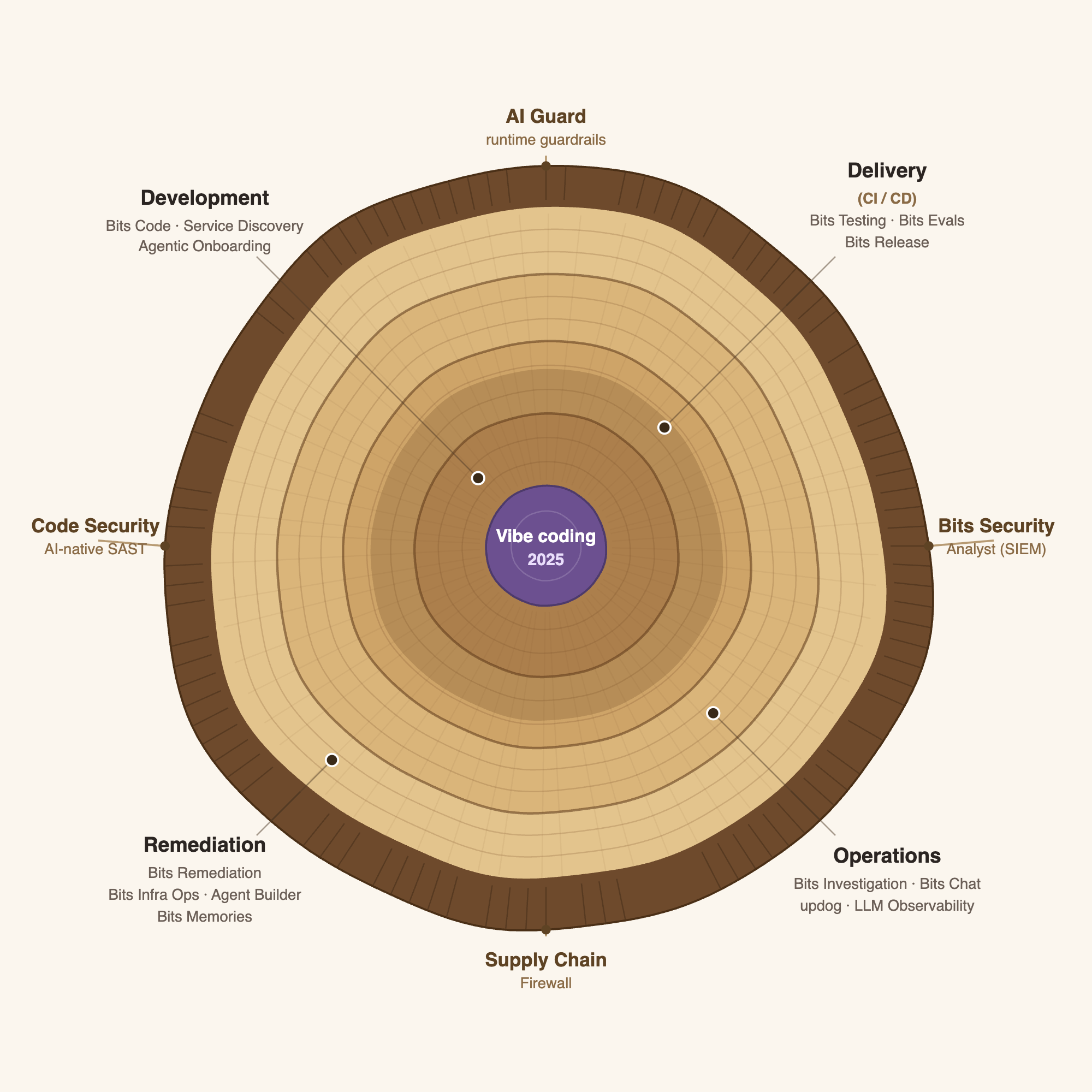
Vibe coding, 2025, was the central point. Bits in 2026 is the set of equidistant points. We’ve closed the loop on AI being part of every aspect of service development, delivery, and operations.
From developing a new feature, to rolling it out to a small portion of prod traffic with feature flags, to fixing issues with the new feature, Datadog is now capable of providing an unprecedented level of not just observability awareness, but increasingly, the ability to actually resolve incidents.
If you read through all five of the official Datadog DASH 2026 blogs, you’ll realize there’s a theme, and it’s not just closing the loop. It’s connecting the dots.
If 2025 was the year of vibe coding, 2026 is the year of VibeOps.
Notebooks First. Dashboards Second. Monitors Third.
You don’t have to manually configure hundreds of monitors and etch runbooks into stone tablets in Confluence anymore. Please don’t.
I’ve long advocated for a notebooks-first, dashboards-second, monitors-third workflow in Datadog.
Notebooks are where you make the sausage (actually grokking the “patterns in the sound”) or meaningful signals in your metrics, logs, and traces.
Dashboards are where you plate the sausage and refine your understanding of when a certain signal hits a threshold that becomes, or is likely to become, problematic.
Monitors are how you deliver the sausage to customers in their homes. And you can literally click to create a monitor from a dashboard widget.
In the 2026 era of VibeOps, you don’t even have to follow that three-step workflow yourself.
Ask Bits Chat to draft a notebook describing the runtime environment for the service you need to monitor. Next, ask Bits to create dashboards that show the relevant service layers.
Then ask it to build a “SPOG,” or single pane of glass: a top-level service dashboard that surfaces the metrics most closely correlated with the four golden signals (a Google SRE term, not a Datadog one). That dashboard should link to the relevant CDN and front door, service layer, middleware, and backend dashboards based on the deployment footprint.
Do this and you’ll be ahead of how most teams operate, even in 2026.
Then, the first time something goes bump in the night, or hopefully before it does, you just have to ask Bits to investigate. After an RCA is found, ask Bits to draft a runbook that you can attach to relevant monitors so the system is aware of prior incidents, can reference them during future investigations, and can even begin automatically remediating known issues. Better yet, sign up for the Bits Memories preview to take that to the next level.
In the era of VibeOps, you don’t have to be at your computer to do any of this. You can ask Bits in natural language in the Datadog mobile app, so the on-call doesn’t have to leave dinner.
Bits AI: Focused Agents for Real Operations Work
None of that is hand-waving. Every "ask Bits to..." step above is a shipped product now, with a name, not a roadmap promise you have to squint at. Think of them as the specialists on that ops team we keep talking about, each one scoped tight enough to actually be good at its one job:
Datadog’s platform-wide coding agent, and the one that’s already GA. It doesn’t just point at the bug. It writes the fix and opens the PR, grounded in your real telemetry. This is the agent that turns “we found the root cause” into “the root cause is merged.”
Follows a change from pull request all the way to production, runs the validation, and promotes the checks that matter into real monitors. It’s the difference between shipping and shipping with your eyes open.
Builds and maintains your detection coverage off what Datadog already knows about your services and dependencies. This is where you stop hand-configuring the hundreds of monitors we just told you to quit chiseling.
Once an investigation lands on a root cause, this is the agent that does something about it, inside guardrails you define. An API call, a kubectl command, a code-fix PR. You decide how much rope it gets.
The one that quietly handles the 2 a.m. nonsense: disk saturation, CrashLoopBackOff, OOMKilled, an expiring TLS cert, before any of it escalates to a human leaving dinner.
Bits Agent Builder
When none of the above fits your exact workflow, you describe the agent you want in plain English and build it on Datadog's Workflow Automation. Bring your own specialist.
Updog.ai and the Third-Party Dependency Problem
But sometimes the problem is not inside your environment at all.
That’s where Updog.ai comes in. Updog.ai from Datadog points AI at boring old observability, not at your agents. It watches the third-party providers you lean on and helps flag provider-side outages before your own dashboards have worked out that it isn’t your fault.
When half your stack is somebody else’s API, that’s the difference between a five-minute “it’s AWS, not us” and an hour spent chasing ghosts.
Context Windows Are the Productivity Window
If you’ve done any meaningful work with AI, you know that your context window is your productivity window. When you don’t have the right context, productivity is zero or low. When compaction happens, productivity falls off a cliff. Once the agent has sufficient context and room to work, you’re off to the races until the window fills and compaction happens.
Whether it’s Claude fanning out a swarm of research agents, LM Studio using speculative decoding to do token generation with a draft model, or your agent orchestration platform making sure each agent is narrowly but sufficiently scoped, managing context windows IS the game when it comes to being productive with AI.
That’s why there are so many new Bits features. Your ops team is a team, right? One person is a little stronger in frontend, another is stronger in backend, another understands the CI/CD pipeline best, and so on.
If you tried to make a general-purpose, or even mixture-of-experts model do everything, the costs would be prohibitive (like a lot of teams felt they were for Bits AI SRE a year ago). Now, Bits Investigation runs at roughly 75% of its launch cost. Our own breakdown of Datadog’s AI Credits model has the receipts; Datadog’s DASH posts don’t quote a specific figure.
The same logic applies to people. You wouldn’t hire exclusively full stack staff level engineers for every headcount, you need focused agents with focused context windows to use AI efficiently and productively.
The Job of Operations in 2026
The job of a SOC analyst, NOC analyst, infra/platform/DevOps team member, or SRE in 2026 is to know which agent to vibe with and how to give it just enough context to get the job done.
It’s all about making things as simple as possible for the agent, but knowing where the line to oversimplification is: the point where the solution is no longer good enough.
AI-Assisted Operations vs. AI Observability
There’s doing observability with AI, which is what we’ve talked about up till now. It’s the same old observability practice, but AI is integrated into every stage of not just observability and operations, but really the entire SDLC now.
Picture a cross-section of a tree. Vibe coding in 2025 is the heartwood at the dead center, the thing everything grew out of. The 2026 AI-driven SDLC is the growth rings layered around it. And secure operations is the bark: its own living layer, wrapping the whole trunk, occasionally feeding back in.
Then there is AI observability.
There’s a whole new set of challenges around understanding what your agents are doing, what kind of prompts they’re getting, and how you’re doing against rate limits. That new set of challenges is what we mean when we say AI observability.
What Datadog Is Shipping for AI Observability
Here’s the dog’s honest truth: AI observability is being invented in real time, and anyone who tells you they’ve got it nailed is selling something.
We won’t pretend to be experts in a field this young. It’s changing every day. What we can do is point at what Datadog shipped for it and tell you where the sharp edges are. It’s called the bleeding edge for a reason.
Every one of these is live today, ready to roll out or test, not a roadmap slide.
Datadog LLM Observability
Traces every call your agents make. It’s the foundation the rest of this sits on.
Patterns in Agent Observability
Clusters those calls into behaviors on its own and ranks them by volume, latency, cost per interaction, and error rate. This is how you find the one prompt that’s quietly costing you a fortune.
Bits Evals
Takes the tedious part of the agent-dev loop off your hands: forms a hypothesis, cross-references traces against your eval results, and tells you which prompt change or dataset gap is the real problem.
Datadog AI Guard
Sits inline against prompt injection, tool misuse, and data exfiltration. Assume your agents will get attacked, or do something dumb on their own, and plan for it.
Runtime Prioritization Engine
Cuts vulnerability noise down to the handful of things that are actually reachable and actually matter.
Datadog Agent Console and Datadog AI Impact
Squarely in NoBS's lane: governing the agents your own engineers are already running. Who's leaning on Claude Code, Cursor, and Copilot, what it's costing, and whether it's making the team faster or just busier.
AI cost tracking in Datadog Cloud Cost Management
Puts AI spend across Anthropic, OpenAI, Amazon Bedrock, and the rest in one place, so “how much are we spending on AI?” stops being a guess.
The NoBS Take
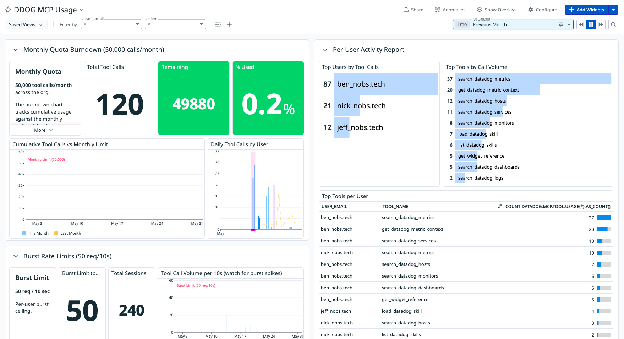
From Lapdog (a local Agent Observability tool that captures every span, prompt, tool call, and cost from a coding agent like Claude Code, no Datadog account required) to Dispatch Agents, to our own NoBS Datadog MCP Usage Dashboard, there are already tools built by Datadog and NoBS to help you understand how your agents are behaving.
That visibility matters because when an agent does not perform as expected, you need to know what it did, what context it had, which tools it called, and where the workflow broke down.
But the practical point is simple: AI does not remove the need for good observability hygiene.
It makes the quality of your context matter more. If your tags are inconsistent, your dashboards are stale, your monitors are noisy, your runbooks are outdated, and ownership is unclear, agents will not magically fix that. They will inherit the mess. Probably faster than a human would.
FAQ: Datadog DASH 2026, Bits AI & VibeOps
Last updated: 2026-06-18
What was the biggest takeaway from Datadog DASH 2026?
Datadog DASH 2026 showed Datadog moving beyond traditional observability toward AI-assisted operations across development, release validation, incident investigation, remediation, and AI observability.
The platform is not just helping teams see what happened. It is increasingly helping teams understand why it happened, what changed, what to do next, and how to take controlled action.
What is VibeOps?
VibeOps is agent-assisted operations: using AI agents grounded in telemetry, context, permissions, memory, and guardrails to help teams operate software systems faster and more safely.
That can include investigation, release validation, runbook generation, monitor improvement, RCA support, and remediation workflows.
Is VibeOps the same as letting AI run production?
No. VibeOps should not mean giving AI unrestricted access to production.
The useful version of VibeOps means using agents within defined workflows, with clear guardrails, human approval where needed, and strong observability context. It should be controlled, observable, and accountable.
What is the difference between AI-assisted operations and AI observability?
AI-assisted operations uses AI to help operate software systems. That includes incident investigation, release validation, monitor suggestions, runbook creation, and remediation support.
AI observability monitors AI systems themselves, including prompts, traces, tool calls, costs, errors, evals, guardrails, and agent behavior.
Why do Datadog tags matter for AI-assisted operations?
AI agents need clean operational context.
In Datadog, tags help define services, environments, ownership, teams, dependencies, and impact. Inconsistent tags limit what agents can understand, summarize, correlate, or act on.
If the tags are messy, the agent's understanding will be messy too.
Why does Datadog have multiple Bits AI agents instead of one general agent?
Focused agents are more practical than one giant general-purpose bot. Different operational jobs need different context, permissions, and guardrails.
Bits Code, Bits Release, Bits Detection, Bits Remediation, Bits Infrastructure Operations, Bits Agent Builder, and Bits Memories each point at a more specific operational workflow. That specialization helps teams use AI more efficiently and avoid treating every problem like the same generic prompt.
Why does agent memory matter for operations?
Agent memory matters because operations teams should not have to rediscover the same incident context every time something breaks.
If prior investigations, runbooks, remediations, and outcomes can be retained and reused safely, future investigations can start with better context. The caveat is that retained context needs governance. Bad memory is not better than no memory.
How should teams prepare for Datadog Bits AI?
Teams should clean up the foundation before relying heavily on AI-assisted operations.
That means reviewing service ownership, tagging consistency, dashboard hygiene, monitor quality, runbook accuracy, alert routing, prior incident documentation, cost visibility, and guardrails around what agents can see and do.
The better the operational context, the more useful the agent becomes.
Ready for VibeOps?
Reach out to the NoBS team if you’re ready to enter the era of VibeOps, and quit chiseling your runbooks into stone tablets in Confluence like cave people. Or, more practically: before you hand more work to agents, make sure Datadog gives them something useful to work with.
NoBS helps teams clean up, optimize, and scale Datadog so AI-assisted operations has a real foundation: consistent tags, useful dashboards, sane monitors, trusted runbooks, reusable incident context, cost visibility, and practical guardrails.